BrewNoted
Why Does My Matcha Latte Taste Weak? Milk, Ice & Dose Checks
Troubleshoot a watery or overly milky matcha latte with a measured comparison. Separate powder dose, milk volume and melting ice before buying another tin.
Same matcha, more milk: see the dilution
An original illustrated concentration example, not a prescribed recipe or a measurement of taste or caffeine.
English on-screen captions · Silent · Vertical video
Download video ↓Read the full text version
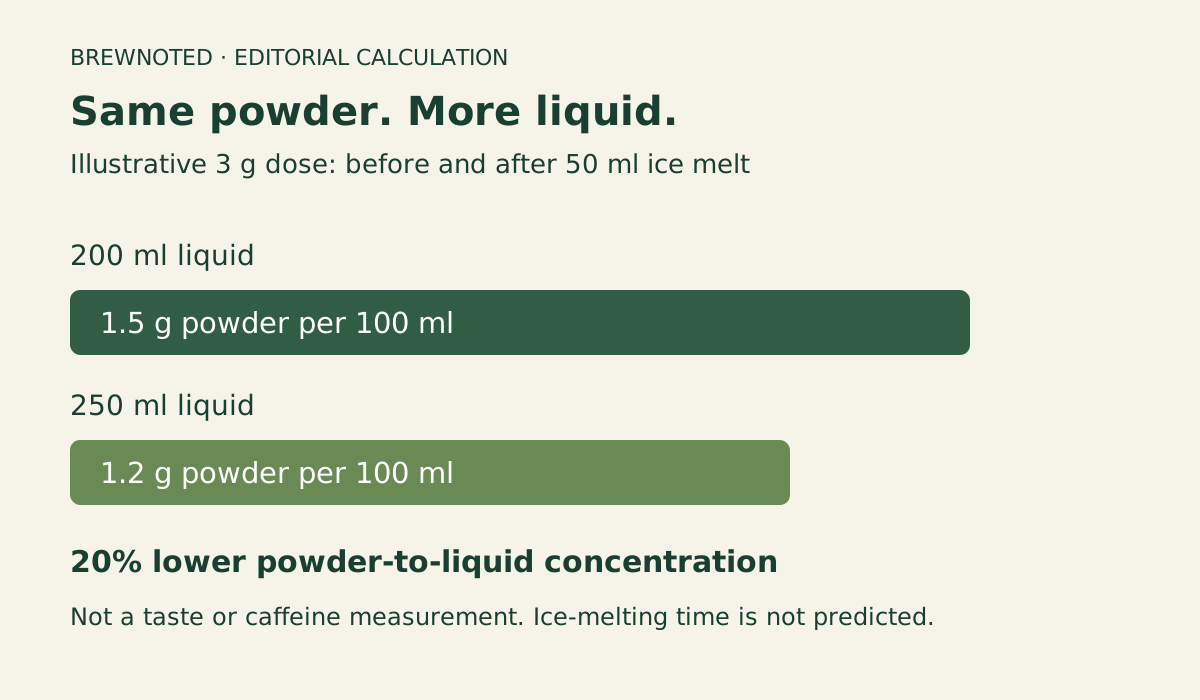
An illustrative 3g of matcha in 200ml of liquid is 1.5g per 100ml. Adding 50ml of milk gives 250ml with the same 3g of powder: 1.2g per 100ml, a 20% decrease in powder concentration. Keep the powder and milk type fixed when comparing liquid amounts. Taste is not determined by arithmetic alone.
Research-based guide, not a hands-on test. Official facts are attributed below. Calculations and suggested comparisons are editorial examples, not measured product performance.
| Question | What to compare | Next step |
|---|---|---|
| Weak immediately | Powder and total liquid | Measure before changing brands |
| Weaker after waiting | Ice and tasting time | Repeat with a consistent interval |
| Powder pockets | Mixing and sifting | Resolve clumps before adding powder |
| Different after changing milk | Milk product and sweetener | Change one ingredient at a time |
First identify when it tastes weak
Taste and record the drink immediately after mixing, then again at a consistent later point. If it starts balanced and becomes watery, the next experiment should focus on ice and elapsed time. If tea is difficult to notice from the first sip, record the powder dose and liquid volumes first. These observations help you choose a test; they do not prove that one ingredient is defective.
Use a published recipe as a reference
Ippodo’s iced latte uses 3 g matcha, 100 ml water at 80°C and 100 ml cold milk, plus ice. It calls for sifting and whisking the matcha before combining. This is one attributed starting point, not a universal strength standard. Use it to identify how your current recipe differs, rather than treating every café-sized glass as the same serving.
Measure the milk instead of filling the glass
In an illustrative comparison, 3 g powder in 200 ml combined water and milk is 1.5 g per 100 ml before ice. Keep the powder fixed and increase the combined liquid to 300 ml: the arithmetic becomes 1 g per 100 ml, a third lower. This describes powder per liquid volume, not measured flavor intensity or caffeine. Try changing only the milk quantity, and record whether you actually prefer the result.
Check ice without blaming the powder
For an arithmetic example, adding 50 ml of melted ice to 200 ml liquid increases the liquid total to 250 ml. The same 3 g powder now corresponds to 1.2 g per 100 ml instead of 1.5. Real ice melt depends on your setup; this is not a timed prediction. Keep ice amount, glass and tasting interval consistent when comparing two recipes. Do not compare a fresh drink with one that has sat on a desk for half an hour.
Separate clumps from low concentration
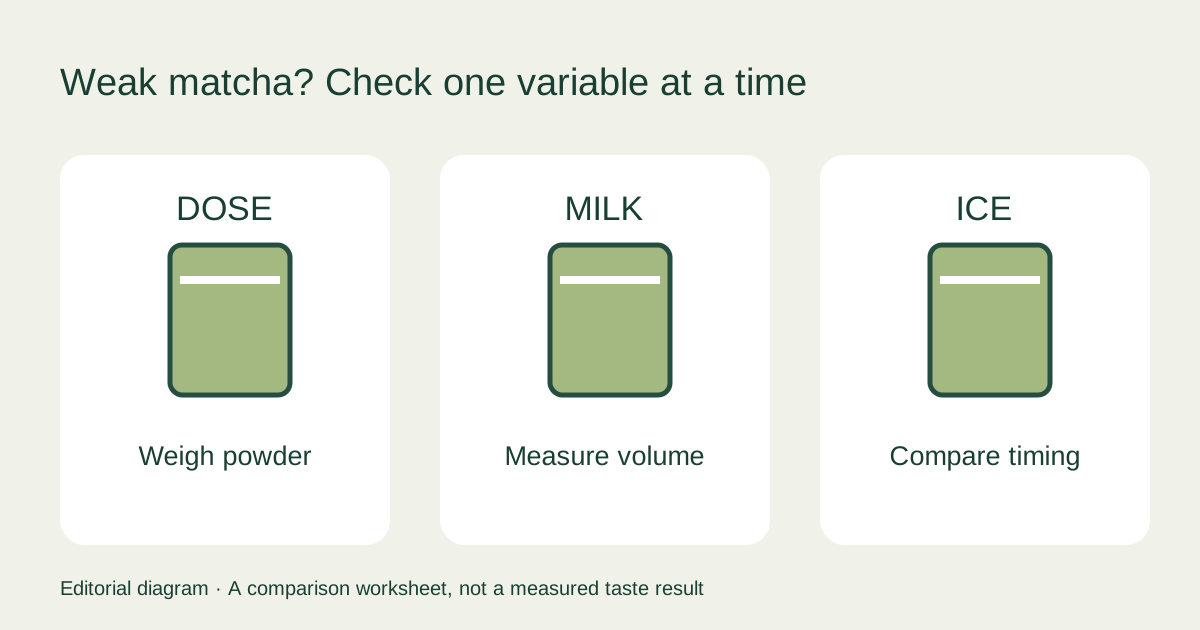
Visible dry pockets or powder left on the whisk mean the measured dose may not all be evenly incorporated. Inspect the mixing bowl and glass before increasing the dose. A drink can have both mixing and proportion problems. Fix the preparation step first, then compare the same measured recipe again. Adding more powder to an unresolved mixing problem may simply leave more clumps.
Keep the milk and sweetener constant
Changing from one milk product to another can also change sweetness and the flavor you perceive. Read the ingredient labels and use the same product for a controlled trial. Leave added syrup unchanged while comparing milk volumes, then test sweetness separately. We have not ranked dairy and plant milks for this recipe, and a label alone cannot tell us which you will enjoy.
Use a two-drink experiment rather than replacing everything
Make two small trials with the same powder, water, milk product and mixing method. Change one quantity, label the glasses and note time, taste and preference. Keep a written recipe so the next purchase does not erase what worked. If neither result suits you, return to the baseline before testing another variable. A stronger drink is not automatically a better one.
Should I add more powder or use less milk?
Choose one adjustment and keep the other quantities fixed. Reducing milk changes serving size; adding powder changes the amount of tea used and the cost per drink. Neither is a neutral adjustment. If your aim is a fixed glass size, record water and milk separately and account for the ice instead of filling to a line by eye. The best result is the recipe you prefer and can repeat, not simply the highest numerical powder concentration.
Use a dilution check with explicit units
For an illustrative 3 g dose, 200 ml combined liquid gives 1.5 g powder per 100 ml. With 50 ml additional melted ice, the total becomes 250 ml and the ratio is 1.2 g per 100 ml: 20% lower. These are arithmetic concentrations, not measured flavour, extraction or caffeine values. The example assumes the stated melt volume has entered the drink; it does not predict how fast ice will melt. Record the same tasting interval for each trial.
How we research these guides · Find your next step