BrewNoted
Usucha vs Koicha: Matcha Ratios, Texture & Cost per Bowl
Understand thin and thick matcha with attributed preparation quantities, a fourfold powder-to-water comparison and a practical first-bowl plan.
Sources checked October 21, 2026. This is a research-based comparison, not a hands-on test or taste ranking. Manufacturer facts are attributed; worked examples and decision worksheets are our editorial analysis. Illustrations are schematic, not photographs.
| Ippodo reference / calculation | Usucha | Koicha |
|---|---|---|
| Powder | 2 g | 4 g |
| Water | 60 ml | 30 ml |
| Water temperature in reference | 80°C | 80°C |
| Mixing in reference | Vigorous whisking | Slow back-and-forth mixing |
| Powder per 30 ml water | 1 g | 4 g |
| Full portions from 20 g, before loss | 10 | 5 |
The names describe how the bowl is prepared
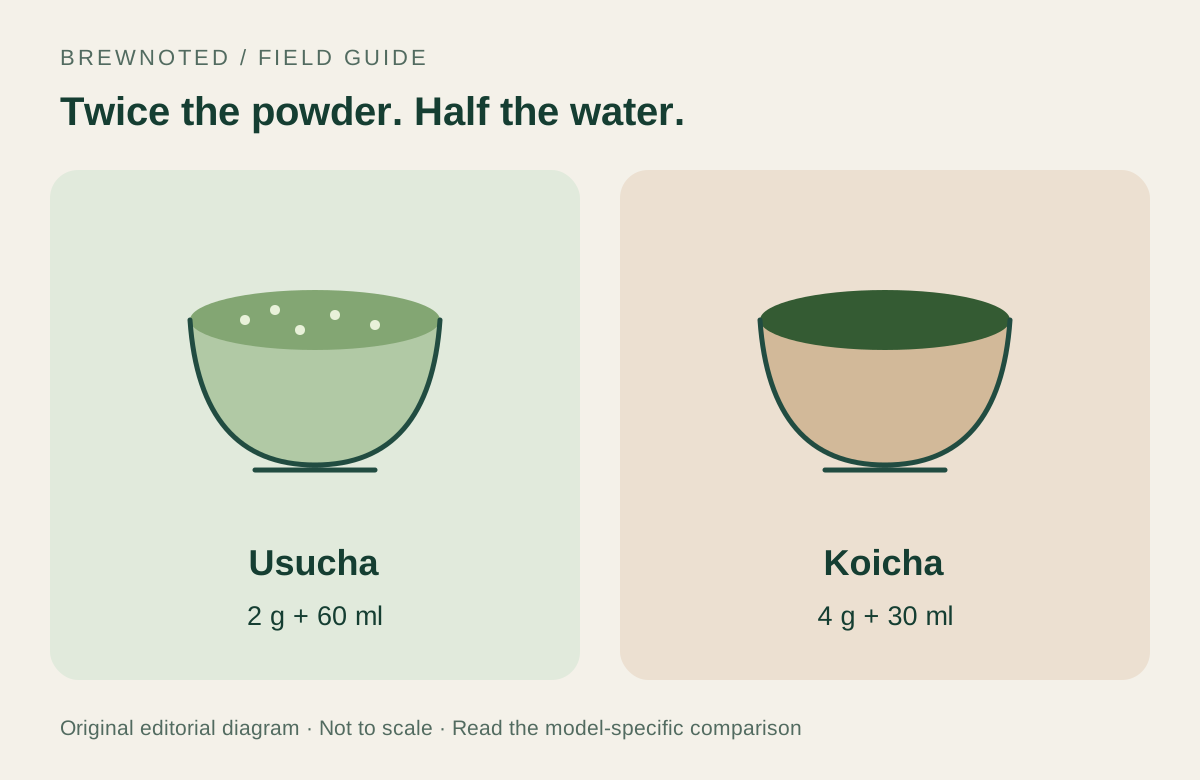
Usucha is commonly translated as thin tea, while koicha is thick tea. Ippodo presents these as different ways of preparing matcha, with different quantities and mixing. Do not assume a package labeled ceremonial tells you which exact recipe to use. Read the producer’s preparation guidance for that tea. A suitable starting method is more useful than treating a marketing label as a complete instruction sheet.
The numerical difference is larger than it looks
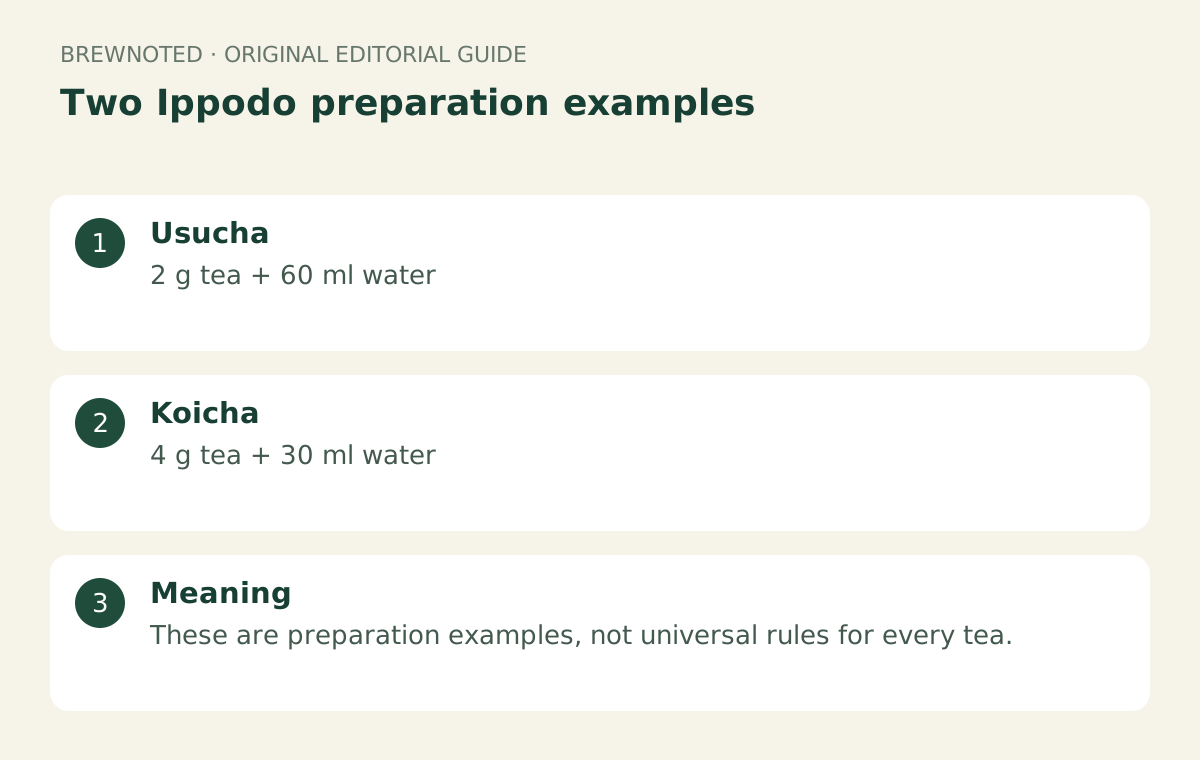
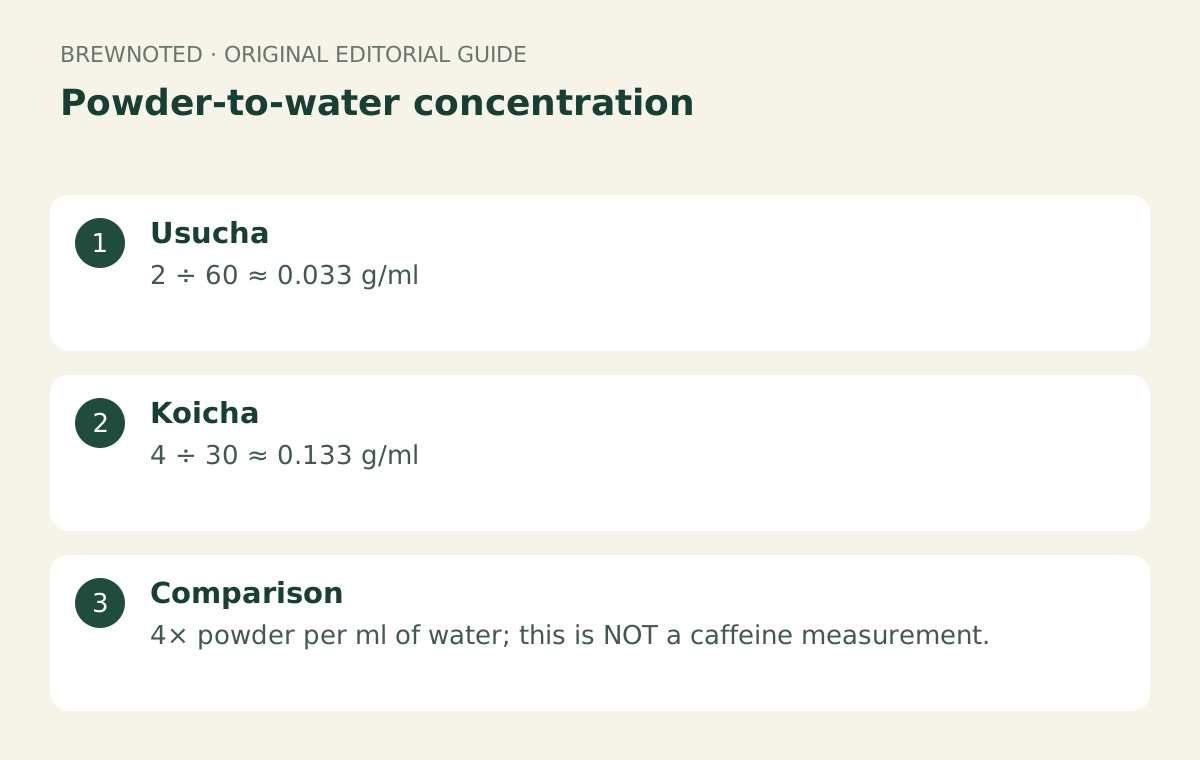
Ippodo’s published examples use 2 g powder and 60 ml water for usucha, and 4 g with 30 ml for koicha, both at 80°C. Dividing by the same 30 ml water amount gives 1 g versus 4 g powder. That is four times the powder-to-water proportion, even though the powder dose per serving is only doubled. This is arithmetic about the recipe, not a claim that perceived flavor or caffeine is exactly four times greater.
A thicker bowl is not a failed foamy bowl
The reference usucha method calls for vigorous whisking, while koicha is mixed slowly. Consequently, judging both preparations by the same foam target misses the point of the comparison. For your first attempt, follow the stated technique and measure carefully. If there are unmixed pockets, revisit sifting and mixing instead of adding enough water to erase the recipe distinction. Keep a note of any deliberate adjustment so you know what you tasted.
The cost per serving changes even within one tin
For a hypothetical 20 g tin costing $24, the powder costs $1.20 per gram. A 2 g bowl uses $2.40 of powder, while a 4 g bowl uses $4.80. Before handling losses, that tin supplies ten or five complete portions respectively. Those are example prices, not an Ippodo quote. If you alternate styles, calculate each dose rather than dividing the tin price by a single advertised serving count.
Choose a small learning session
You do not need to buy several large tins to understand the difference. Select a tea whose producer describes both preparations, read the instructions and make one measured bowl at a time. Note texture, intensity and whether you would choose that preparation again. Do not turn the exercise into a competition to consume every example. Learning the distinction is possible through careful preparation and a short written observation.
Where a latte fits—and where it does not
Adding milk creates another recipe question. A concentrated matcha base for a latte should not automatically be called koicha, because the intended finished drink and method may differ. Use an actual latte recipe when that is the drink you want. Likewise, pouring a large amount of water into a thick preparation may yield something enjoyable, but record it as your adjustment instead of claiming you followed the original reference exactly.
Are the two reference ratios 1:30 and 1:7.5?
Expressed as grams of powder to milliliters of added water, yes: 2:60 simplifies to 1:30, and 4:30 to 1:7.5. State those units when sharing the calculation. They are not measurements of dissolved solids or finished beverage volume. Powder remains part of the prepared drink, and perception is not a linear scale. The calculation helps you reproduce a reference, not predict how another person will describe its intensity.
A sensible first choice
If you are learning to whisk and want a straightforward bowl, the usucha reference is a clear place to start. Investigate koicha when you specifically want to explore its thicker preparation and the producer recommends that use. Neither method is a compulsory quality test for a tea or its drinker. Keep the exact powder, dose, water and mixing notes so the next bowl builds on what you learned.
Budget by weighed portions, not spoon names
Using these example doses, a 20 g tin contains ten 2 g portions or five 4 g portions before any handling loss. That makes portion planning more useful than assuming every bowl uses the same amount. Weighing is especially helpful when comparing powders with different packing densities or when using different spoons. The fourfold powder-to-water calculation describes the recipe concentration only; it is not a measured caffeine or flavour intensity result. Start with the producer's preparation guidance for the tea you own. A thicker preparation can expose aspects of a tea that milk or a larger water quantity would otherwise dilute.
How we research these guides · Find your next step